BOD and Dissolved Oxygen in Rivers Explained
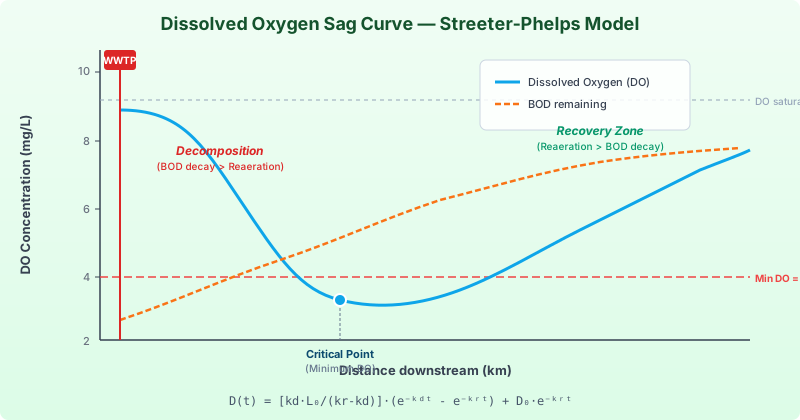
If you've ever studied environmental engineering, the "oxygen sag curve" is one of the first concepts you encounter. It elegantly describes how dissolved oxygen drops downstream of a pollution source and then recovers — a phenomenon explained by the interplay between BOD decomposition and atmospheric reaeration.
Simulate dissolved oxygen with Streeter-Phelps
Model the DO sag curve in your river using the classic Streeter-Phelps calculator
Open Streeter-Phelps CalculatorWhat is BOD?
Biochemical Oxygen Demand (BOD) measures the amount of oxygen consumed by microorganisms as they decompose organic matter in water. A high BOD means the water has a lot of organic pollution — think wastewater, food processing effluent, or agricultural runoff.
- BOD₅: The standard 5-day test — amount of DO consumed in 5 days at 20°C
- Ultimate BOD (BODu): The total oxygen demand when all organic matter is decomposed
What is Dissolved Oxygen?
Dissolved Oxygen (DO) is the oxygen available in water for fish, invertebrates, and other aquatic organisms. DO levels depend on: Temperature, Reaeration, Photosynthesis, and Respiration.
The Streeter-Phelps Equation
In 1925, Streeter and Phelps published their landmark model for the Ohio River. The equation describes the DO deficit (D) at any point downstream:
D(t) = [kd·L₀ / (kr - kd)] × (e^(-kd·t) - e^(-kr·t)) + D₀·e^(-kr·t)
Why It Matters
Most water quality standards require a minimum DO of 4–5 mg/L to sustain fish populations. When a wastewater plant discharges into a river, engineers must calculate whether the DO will drop below this threshold. This is exactly what QUAL2K does — but with far more sophistication than the original Streeter-Phelps model, including nutrients, algae, and diurnal (day-night) variations.
Ready to model your own river?
Put what you just read into practice with the full QUAL2K prediction engine
Try the free QUAL2K wizard